Paver Joint Sand in Nocatee, FL
Why joints lose material, how HydroSeal restores depleted paver joints, and how joint stabilization fits a complete sealing project.
The joints are the paver system. The sealer is just the finish.
Homeowners judge a paver job by the sheen. Installers judge it by the joints, because that is where the engineering actually lives. An interlocking paver surface carries load by transferring it sideways between units through a compacted sand joint. Empty the joints and every paver becomes an independent block sitting on sand, free to rock, settle and separate.
This is why a sealed surface over hollow joints looks excellent for one season and then starts moving. It is also why re-sanding is included in the price of every job we do rather than sold as an upsell — driveway sealing, pool deck sealing and travertine all include a full joint reset at $1.50 to $1.60 per square foot.
Local conditions
Why Nocatee joints empty faster than they should
Irrigation and runoff can move joint sand. Reclaimed-irrigation overspray, roof discharge, driveway slope and repeated wetting can erode low joints and edges over time. HydroSeal looks at sprinkler patterns, drainage paths and actual joint depth before deciding how much material needs to be restored.
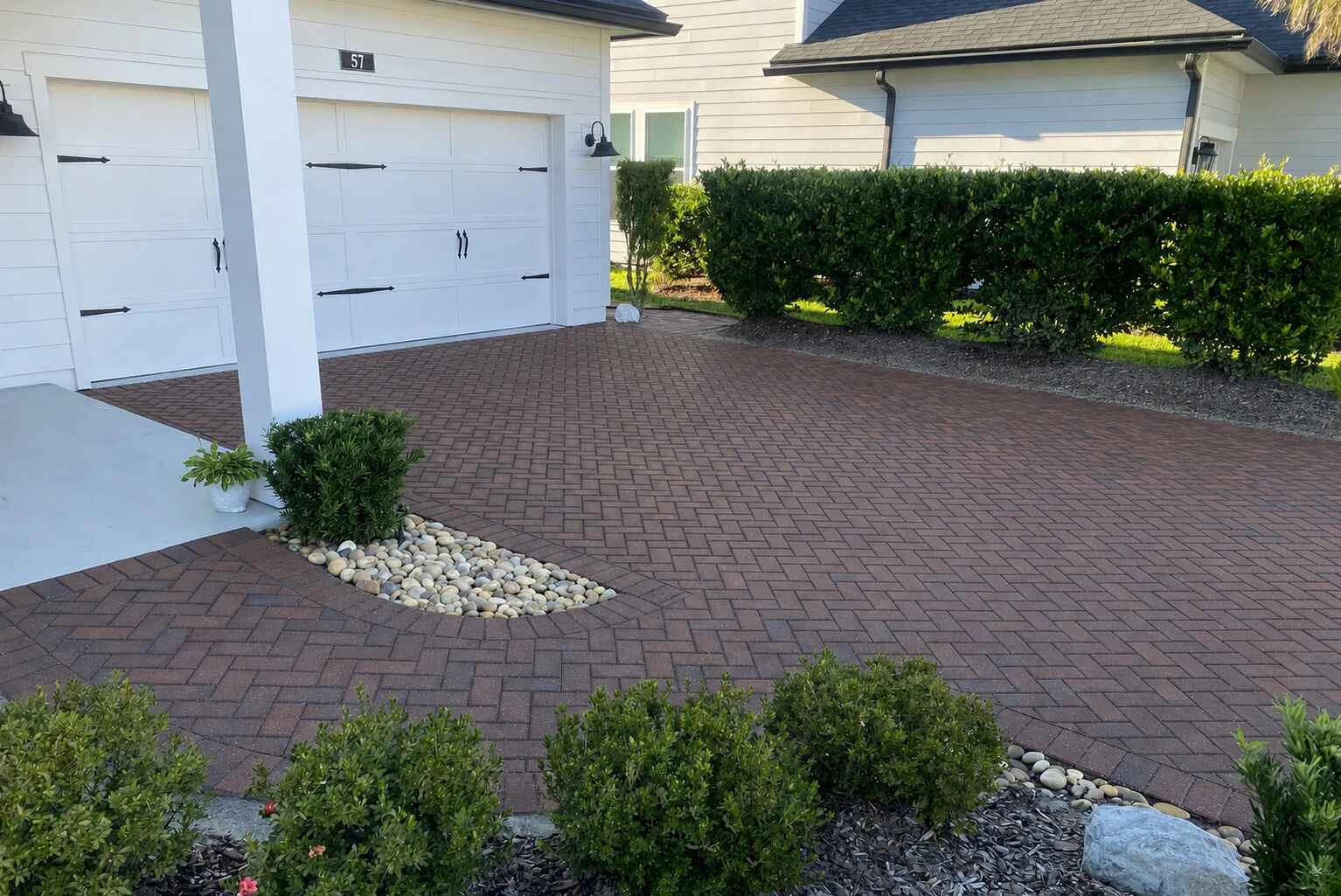
Storm season concentrates the damage. June through September moves serious volume across surfaces that were all designed to shed somewhere — driveways toward the street, pool decks toward drains and the waterline, walkways toward the lawn. The joints at the low end of that path go first. On most Nocatee driveways the apron is visibly emptier than the top of the drive.
New installations can settle after the first sanding. Some paver systems lose visible joint depth as the original sand settles into the joints or is displaced by early rain and cleaning. The existing depth should be measured rather than assuming every newer installation needs the same correction.
The practical trigger is visible depletion: when joints are noticeably low, edges begin losing support, sand movement increases or pavers start shifting, the joint system should be evaluated and restored to the appropriate working depth.
Method
How we reset a joint properly
- Remove what is failing. Old sand that is contaminated with organic growth, root mass or degraded polymeric residue comes out. New sand on top of failing material inherits the failure.
- Pre-treat if needed. On surfaces with a persistent weed or ant problem, a pre-emergent goes down before the new sand.
- Fill to full depth. Trident ASTM C144 kiln-dried joint sand, swept in progressive passes rather than one. Sand bridges and leaves voids underneath if you rush it.
- Compact and top off. Vibration settles the sand and always reveals that the joint takes more than the first pass suggested. Skipping the second fill is the single most common shortcut in this trade.
- Clear the surface. Every grain comes off the paver faces before anything wet touches them.
- Stabilize. A joint-stabilizing sealer binds the top portion of the joint into a cohesive mass while leaving the surface permeable enough to drain.
Sand color is a real decision and we bring samples to the estimate. Lighter tones blend joints into the paver field for a seamless look. Darker tones define borders and banding. Mid-tones hide dust between services on mixed-color pavers. HydroSeal offers multiple Trident joint sand colors — see the full joint sand color options on the main site.
The contested question
Polymeric sand in Florida: the honest answer
Most Florida paver companies, this one included, do not use polymeric sand on restoration work. You will also find a credible, well-argued case from a large Florida operator that this consensus is self-serving — that contractors avoid polymeric because stabilizing sealer is more profitable, and that correctly installed polymeric hardens through the full depth of the joint and performs predictably. That argument deserves a straight response rather than a dodge, so here is ours.
The product is not the problem. The conditions are. Polymeric sand works when four things are true at once: the base is properly compacted and well drained, joint widths fall inside the manufacturer's range, the surface is genuinely clean and dry when it goes in, and the weather holds long enough for a full cure. Those are the manufacturer's own conditions, not a competitor's talking points.
On a new install with a fresh base in dry weather, all four are achievable. On a ten-year-old Nocatee restoration job they frequently are not. Shaded screened pool decks hold moisture continuously — chronic damp is exactly the condition polymeric handles worst. Restoration joints are rarely uniform width. And a genuinely dry surface with a four-day cure window is not something you can count on in a Florida summer.
Permeability is the second issue. University of Florida IFAS Extension points out that polymeric sand is not porous, so water cannot pass through it — which runs against the Florida-Friendly Landscaping principle of reducing stormwater runoff. On a Nocatee surface that already sheds toward a street or a pool drain, sealing the joints against drainage moves water somewhere else rather than removing it.
And the failure mode is expensive. When polymeric cracks, the crack has to be repaired to keep pests out — you cannot simply top it off the way you can with loose sand. Worse, if any residue is activated while still sitting on the paver faces, it cures bonded to the surface. Seal over that and the haze and rough texture are locked in permanently. Correcting it means stripping the sealer and mechanically removing cured residue, and it is one of the most common repairs we get called out for in Nocatee and Ponte Vedra.
So the position is narrower than a blanket rule: polymeric sand is a legitimate product that performs well inside its installation window, and we would not tell a homeowner it is worthless. For paver restoration in Nocatee conditions — existing surfaces, irregular joints, scheduled irrigation, screened decks, a four-month wet season — kiln-dried sand under a joint-stabilizing sealer is the more forgiving system, it drains, and when it does eventually need attention you top it off instead of removing it. If your situation genuinely meets the polymeric conditions, we will say so.
Pricing
What joint sand work costs in Nocatee
| Service | Rate |
|---|---|
| Joint sand replacement — included in paver sealing | $1.50 / sq ft |
| Travertine and natural stone joint reset — included in sealing | $1.60 / sq ft |
| Weed and ant pre-emergent pre-treatment | Add-on, quoted per surface |
| Removal of failed or hazed polymeric residue | Quoted after inspection |
| Paver repair or releveling before re-sanding | $8 / paver |
We do not sell re-sanding as a standalone service on most surfaces. Unstabilized sand in a Nocatee joint, with irrigation several times a week and a four-month storm season, starts leaving almost immediately. Paying for sand without stabilization is paying twice. Run a combined estimate on the paver sealing cost calculator.
Service area
Joint sand replacement across Nocatee
Joint reset is part of every job: driveway paver sealing, pool deck sealing and travertine sealing. Nocatee Paver Sealing is the Nocatee service site for HydroSeal, covering St. Johns, Duval and Clay counties.
Questions
Paver joint sand questions
Why does sand keep coming out of my pavers?
Three causes stack in Nocatee. Reclaimed irrigation saturates joints on a fixed schedule several times a week, so they never fully dry. Storm season moves large volumes across surfaces that all shed toward a street or drain. And builder installs often left joints partially filled to begin with. Once a joint drops below about two-thirds depth, interlock is gone and loss accelerates.
Do you use polymeric sand?
Generally no on restoration work, and the reason is installation conditions rather than the product. Polymeric needs a well-drained base, joints inside the manufacturer's width range, a genuinely dry surface, and weather allowing a full cure. Nocatee restoration jobs frequently miss at least one — shaded screened pool decks especially. It is also not porous, which works against drainage. We use Trident ASTM C144 kiln-dried sand with a joint-stabilizing sealer.
Can you just add sand without sealing?
We can, but it is usually wasted money. Unstabilized sand is held by nothing but gravity and friction, and with irrigation several times a week plus storm season it starts leaving immediately. The sealer is what locks the joint.
How deep should joints be filled?
Full depth — most of the paver thickness, not a surface skim. Sand filled only in the top half looks right on the day and delivers almost no interlock, because the mechanical strength of a paver system comes from full-depth compaction transferring load between units.
Will new sand stop weeds and ants?
It reduces both substantially. A full-depth joint locked with a stabilizing sealer is hard for seeds to germinate in and hard for ants to excavate. For persistent problems we apply a pre-emergent before the new sand goes in. Nothing is permanent, but it typically moves maintenance from monthly to seasonal.
What color joint sand should I choose?
Sand color changes the finished look more than most homeowners expect. Lighter tones blend joints into the field. Darker tones define borders and pattern lines. Mid-tones hide dust on mixed-color pavers. We bring samples and lay them on your own surface — full range on the sand color options page.
My last contractor left haze on the pavers. What happened?
Almost always polymeric sand activated with water while residue was still on the paver faces. Once cured on the surface it is bonded there, and sealing over it locks the rough hazy texture in permanently. Correction means stripping the sealer and mechanically removing the residue. It is one of the most common repairs we get called for.
How much does re-sanding cost in Nocatee?
It is included in the sealing price — $1.50 per square foot for concrete and brick pavers, $1.60 for travertine and natural stone. Pre-emergent treatment and removal of failed polymeric residue are quoted separately.
Free estimate
Get a Nocatee joint sand and sealing quote
Send photos of the joints — a close-up showing depth is more useful than a wide shot. Flag anything you have noticed: sand tracking indoors or into the pool, weeds or ant hills, rocking pavers, or haze left by a previous contractor.
HydroSeal — Nocatee Paver Sealing
Serving Nocatee, Ponte Vedra, Palm Valley & St. Johns County, FL
904.537.5000 · info@hydrosealpavers.com
Mon–Fri 8–5, Sat 9–1